Introducing Atomic Dawn: Provinces, Claims & the 1946 Start Date
An introduction to Atomic Dawn and the project behind the Cold War grand strategy game.
Hello!
My name is Silas and I'm the developer behind Atomic Dawn, a grand strategy game set in the Cold War era.
I started this project November 16, 2025, and have been working on it in intermittently in my free time. Now in September of 2026, it has finally reached a state where I feel like it's good enough to share.
I've always wanted to play a grand strategy game set in the Cold War. As a teenager I played Supreme Ruler: Cold War, and had my imagination fill in the blanks where the gameplay, graphics, and content wasn't up to par. I had a blast winning and losing the Korean and Vietnam Wars as both sides, trying to roll back the Russian Communist influence with generous foreign aid, or trying to expand it despite the total lack of prosperity in the Soviet Union at the time. (Playing America was easy mode! I even played Sweden, once, but the lack of a real domestic political simulation made it not so fun).
Then I played other grand strategy games, including Victoria 2, which I loved, especially with the Historical Project Mod. I even made Finland, starting in 1836 as a small nation of 2 million inhabitants under the Russian yoke, into a great power once! Needless to say, I love this genre of games, and I'm really enjoying the process of building one myself.
This is a very ambitious project, and I'm just going to dive right in into what I'm currently working on and find interesting. I'll focus on communicating my vision for this game, rather than trying to provide a perfect overview of everything - that's best saved for when the game is close to complete, anyway.
A map made out of provinces
By far, the thing that has taken the most time about this project has been the in-game map.
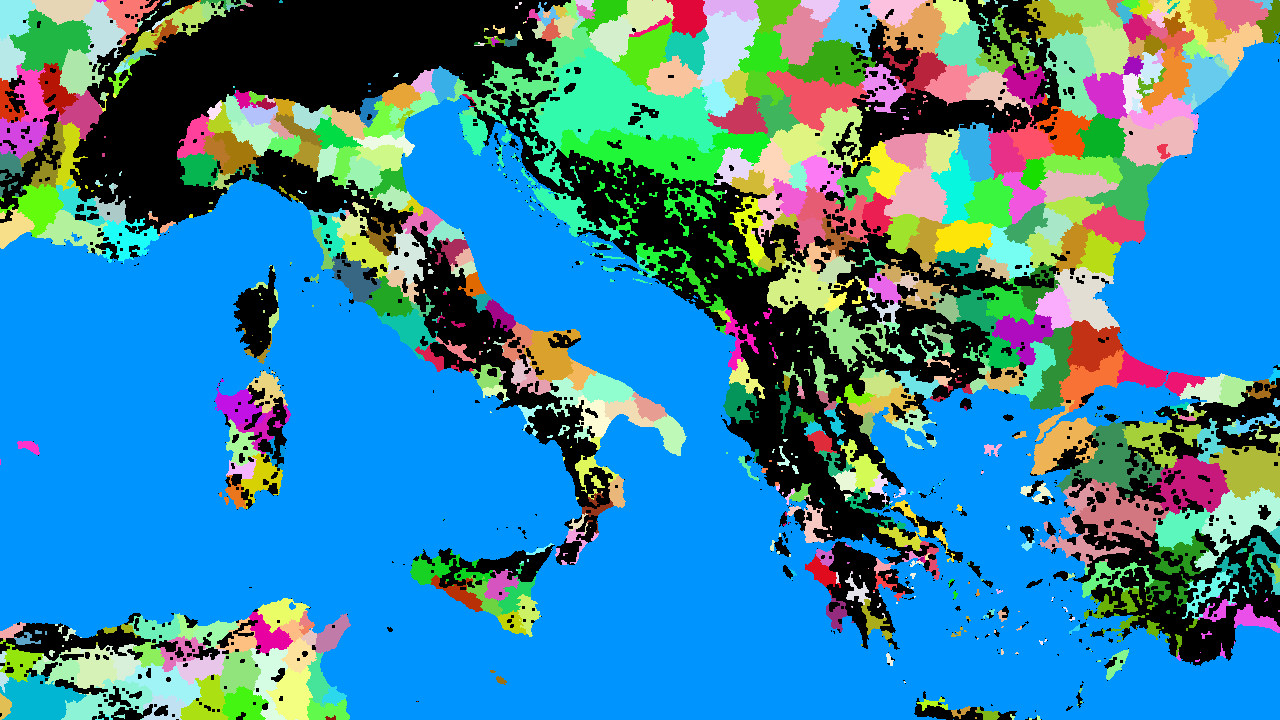
Traditional grand strategy games are built around the concept of provinces, a polygonal subdivision of the world map representing a particular geographic area. The size varies from game to game - in one game, all of New York might be one province, or it could be split into two, coastal and inland, or it could be so detailed that each borough of New York City becomes its own province.
Generally, the more ambitious the game developer, the more provinces you end up with. Provinces matter both for military gameplay, moving military units through them, occupying the provinces of another country, but also for driving the national simulation in both peace-and wartime.
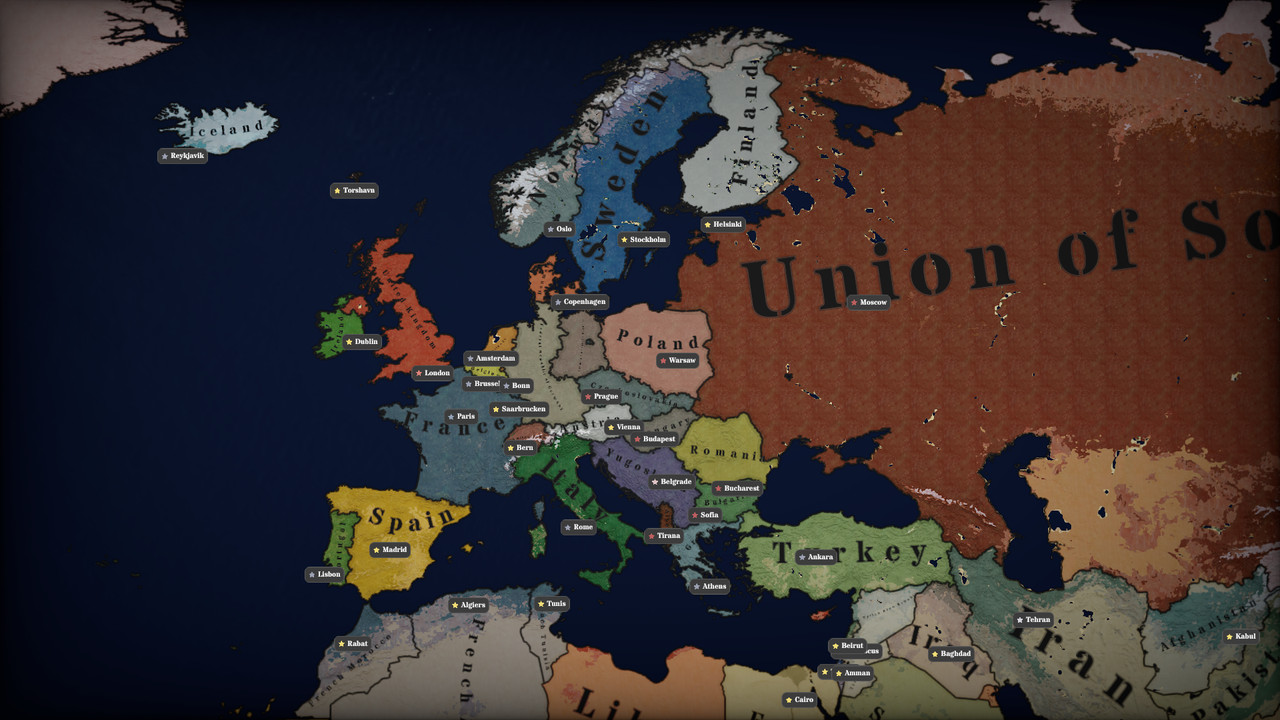
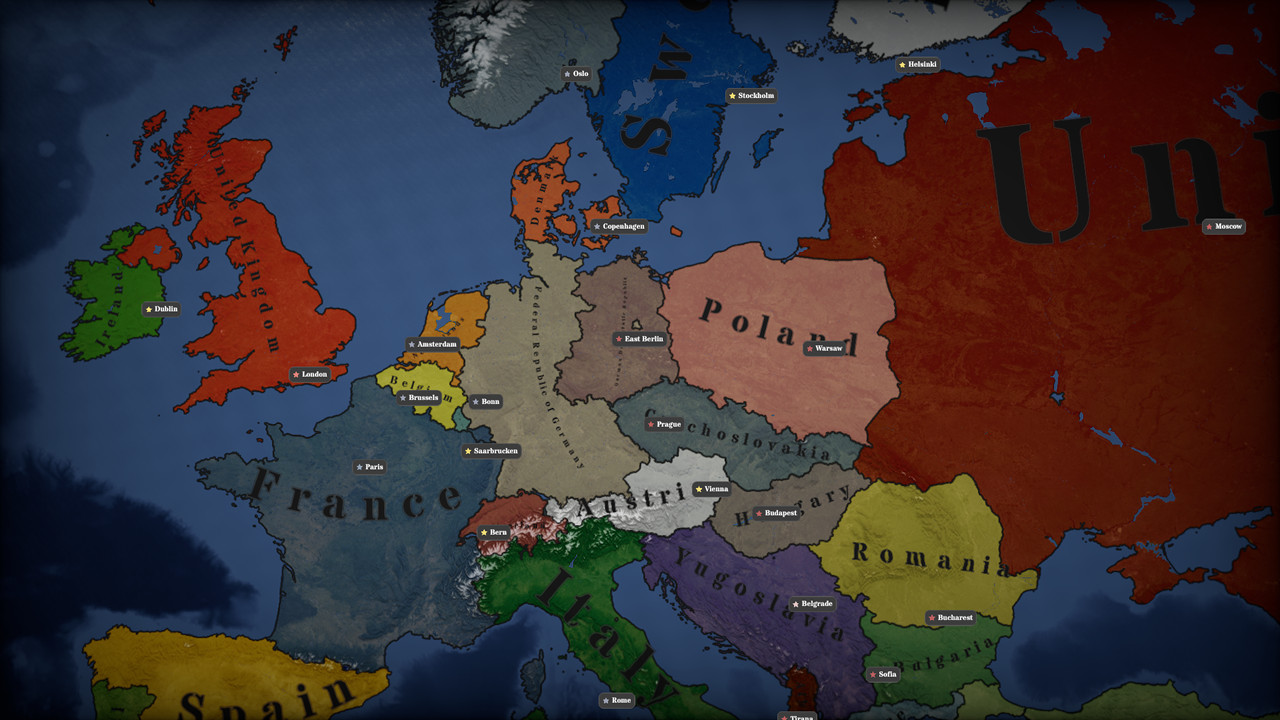
Provinces are associated with data. In Atomic Dawn, each province has a population, a GDP per capita value showing the living standard of that population, an education value, showing how well educated they are; the list goes on. Provinces have a list of claims on them, based on the countries that view those provinces as their rightful national soil. For example, West Germany views all of East Germany as its rightful territory, and East Germany views all of West Germany as its rightful territory.
Claims also work for countries that don't exist on the map. Every constituent republic of the Soviet Union, such as the Baltic States, Ukraine, or Kazakhstan, have claims on the territories that are theirs. They are still part of the Soviet Union, belonging to the same country, but the potential for breaking away is there, and encouraging or preventing separatist tendencies in the Soviet Union and elsewhere is a key gameplay element in Atomic Dawn. Encouragement can be in the form of money, weapons, propaganda, or political support: interacting with the internal factions of other countries is a key gameplay feature of the game.
That's a bit about how the map works. Let's more on to the second thing I'm thinking about today:
Changing the start date from 1949 to 1946
When I started this project, I was certain that I wanted 1949 to be the start date. It's the quintessential Cold War setup: East and West Germany are already established, the Soviets have the Atomic Bomb already, the Communists have won the Chinese Civil War decisively, and the Korean War is just on the verge of breaking out.
But this week, I've reconsidered, and my chief concern is about replayability. I think, for this reason, that 1946 is a better choice for the start date. In 1946, the situation was still a lot more fluid. The Soviets had not yet closed their iron fist over the countries of the Eastern Bloc, the Second World War had just barely ended, and the German situation has not yet fossilized, nor the Korean one - it's an empty canvas. Build your own Cold War.
Another reason, why it makes more sense, is because of the Korean War. If you start in 1949, then the Korean War is the absolute first thing that happens. It has to work, mechanically and content-wise. That's a lot of pressure.
So why not, instead, start in 1946? There might not even be a Korean War, if the Americans and the Soviets end up coming to a constructive solution.
The downside of the 1946 start date is that it requires a lot of historical events, decisions have to be made about the post-war world, and those events have to be written and evaluated, by me, essentially a big burden of content design. But I believe that it will be worth it. It also means that the famous 1947 Iron Curtain speech by Churchill gets to be an in-game event - iconic - and the player is there for the formulation of both the Truman Doctrine and the Marshall Plan.
Maybe we will eventually have one 1946, one 1949 start date - but for now, I'm aiming toward the 1946 start date.